
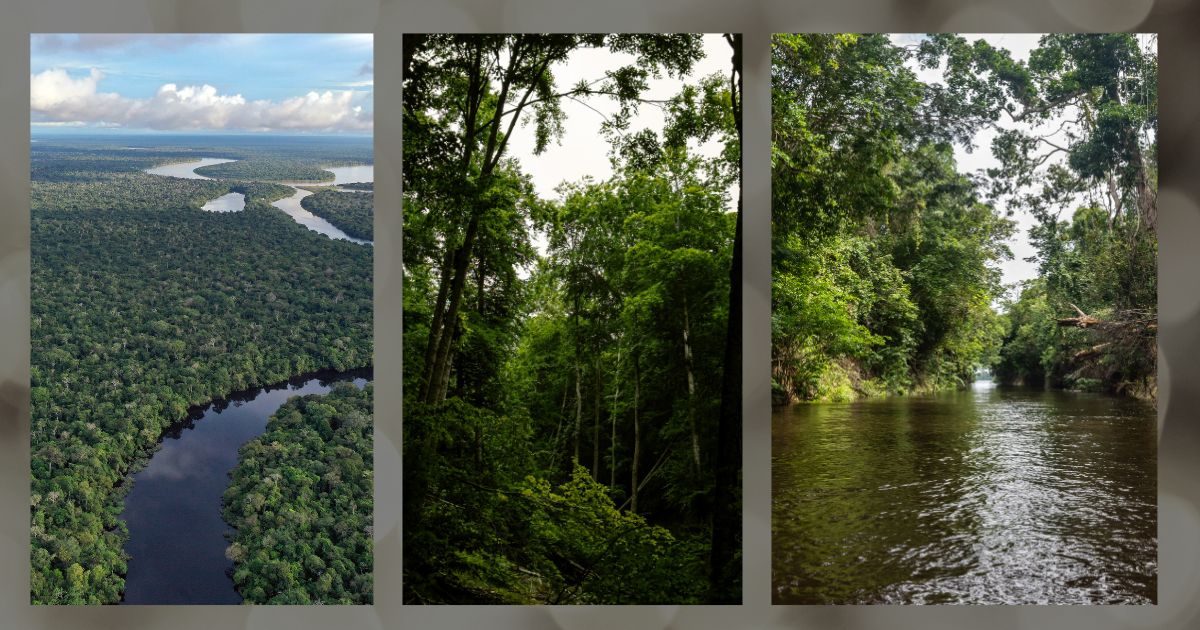
Everyone is looking offshore. Some of Suriname’s greatest capital is already standing on land.
The international investment story around Suriname is currently dominated by oil and gas. That is understandable. Large-scale offshore oil production is expected to transform the Surinamese economy from 2028 onwards.
But while international investors are looking at what lies beneath Suriname's waters, another enormous asset receives considerably less attention:
Suriname's natural capital.
Approximately 93 percent of the country remains covered by tropical rainforest, representing more than 15 million hectares.
Suriname's national climate documentation estimates that its ecosystems contain a carbon stock equivalent to approximately 13.1 billion tonnes of CO₂.
This does not mean that Suriname possesses 13.1 billion tradable carbon credits.
But it illustrates the extraordinary scale of an asset that is largely absent from traditional economic valuations.
Putting 13.1 billion tonnes into perspective
There is no single global carbon price. Prices differ substantially according to quality, methodology, project type, additionality, permanence, biodiversity benefits and market demand.
Nevertheless, applying illustrative values helps demonstrate the potential scale of Suriname's underlying natural capital:
- at USD 7 per tonne: approximately USD 92 billion
- at USD 20 per tonne: approximately USD 262 billion
- at USD 40 per tonne: approximately USD 524 billion
These figures are not valuations of Suriname's forests and do not represent available carbon credits.
They illustrate something more fundamental:
even at relatively modest carbon values, the environmental value represented by Suriname's forests is potentially enormous.
The important question is therefore not whether the entire 13.1 billion tonnes can be monetised. It cannot simply be converted into credits.
The strategic question is what proportion of Suriname's natural capital can responsibly be translated into verified environmental value over the coming decades.
Even a fraction matters
The scale becomes particularly interesting when viewed in percentages.
At an illustrative USD 7 per tonne, an amount equivalent to just 1 percent of 13.1 billion tonnes would represent approximately:
USD 917 million.
At higher values associated with premium nature-based credits, the theoretical scale increases substantially.
Again, this is an illustration rather than a forecast of eligible credits or revenues.
But it demonstrates why carbon and nature capital deserve a place alongside oil and gas in the international investment discussion about Suriname.
Protecting existing carbon
The most obvious opportunity lies in Suriname's existing forests.
Keeping forests standing can potentially create measurable climate value through appropriately structured conservation and avoided-deforestation programmes.
But international carbon markets are becoming increasingly demanding.
Investors and buyers want evidence of:
- additionality;
- credible baselines;
- permanence;
- independent monitoring and verification;
- transparent carbon rights;
- biodiversity benefits;
- community participation;
- strong governance.
This development may work in Suriname's favour.
Its competitive advantage is not simply the quantity of forest.
It is the exceptional quality and scale of an intact tropical ecosystem.
Suriname should therefore not aspire to become a supplier of the cheapest possible carbon credits.
The opportunity is to position itself around high-integrity carbon and nature capital.
Creating new natural capital
There is also a second opportunity.
Natural capital does not have to be limited to protecting what already exists.
New nature-based projects can potentially remove additional CO₂ from the atmosphere while simultaneously creating productive economic assets.
Bamboo is one illustration.
Bamboo and other forms of carefully selected revegetation can potentially combine:
- biological carbon removal;
- productive use of suitable land;
- renewable biomass;
- employment;
- downstream processing;
- export opportunities.
The significance is not bamboo itself.
It is the underlying investment principle:
Suriname can both protect existing natural capital and create new natural capital.
That creates a broader investment strategy than carbon credits alone.
From carbon to nature capital
Carbon is increasingly measurable and therefore provides a useful starting point.
But a forest represents considerably more than stored CO₂.
It also provides:
- biodiversity;
- water protection;
- climate resilience;
- ecosystem services;
- community value;
- sustainable tourism opportunities;
- scientific value.
International financial markets are gradually developing mechanisms to recognise these wider environmental benefits.
This creates opportunities around areas such as:
- forest conservation;
- carbon removals;
- Article 6 mechanisms;
- biodiversity finance;
- restoration;
- sustainable forestry;
- nature-based tourism;
- blended climate finance.
The future opportunity may therefore be broader than a carbon credit.
It is the development of nature capital as an investable asset class.
Oil capital and nature capital
Suriname has an unusual opportunity.
It is entering the global energy market at the same time that international financial markets are placing increasing value on climate and nature.
These represent two fundamentally different forms of wealth.
Oil creates value through extraction.
Nature can create value through preservation and regeneration.
Oil is finite.
Well-managed natural capital can potentially continue producing environmental and economic value for generations.
Suriname does not have to choose between them.
The strategic opportunity is to develop both:
energy capital + nature capital
Oil revenues can help transform the economy.
Natural capital can help diversify and sustain that economy over the longer term.
From natural asset to investable opportunity
Turning natural capital into investable projects is complex.
It requires much more than calculating how much carbon exists in a forest.
Projects need scientific measurement, internationally accepted methodologies, legal structures, monitoring, verification, government authorisation where applicable, transparent ownership and credible governance.
This is where specialist knowledge becomes essential.
The Global Carbon Group (GCG) acts as a knowledge and development partner to the Suriname Investment Platform for carbon and nature-capital opportunities.
GCG brings together international expertise in carbon markets, project development and environmental asset structures.
SIP focuses on identifying suitable opportunities, developing investable structures and connecting projects with international capital.
The objective is to build the bridge from:
natural capital → measurable environmental value → investable projects → international capital
Suriname's hidden balance sheet
Traditional economic indicators tell us about GDP, government debt, exports and investment.
They tell us much less about the economic potential of an intact rainforest.
Yet Suriname has:
- more than 15 million hectares of tropical forest;
- approximately 93 percent forest cover;
- an estimated 13.1 billion tonnes of stored CO₂e;
- exceptional biodiversity;
- significant potential for carbon and nature-based investment.
At an illustrative USD 7 per tonne, the 13.1 billion tonnes of stored CO₂e correspond to almost USD 92 billion of theoretical underlying carbon value.
That is not USD 92 billion of tradable carbon credits.
But it is a powerful indication of the scale of an asset that is largely invisible on Suriname's traditional economic balance sheet.
The world is looking at Suriname's oil
It should also be looking at its trees.
Oil and gas may drive the next phase of Suriname's economic development.
But nature capital could become a second strategic pillar.
The opportunity is not to sell the forest.
It is to create an economic model in which keeping forests standing, restoring ecosystems and creating new biological carbon sinks can generate measurable and sustainable value.
That changes the way we look at Suriname.
The oil beneath Suriname's waters may create wealth for decades.
The natural capital standing above the ground has the potential to create value for generations.
And that may ultimately prove to be one of Suriname's most important hidden assets.
This article is provided for general information purposes only. Carbon values are illustrative and do not constitute a valuation of Suriname's forests or a forecast of revenues. Stored forest carbon does not automatically constitute tradable carbon credits. Credit generation depends on applicable methodologies, additionality, baselines, permanence, leakage, verification, ownership and carbon rights, government authorisation and market conditions. This article does not constitute investment advice, an offer or a solicitation to invest.